
Hinsdale County Court Record Requests
The Clerk of Court at Hinsdale Combined Court holds the case files for both trial tiers. That office covers District Court and County Court alike. Don't confuse it with the elected Hinsdale County Clerk. That clerk handles recording, elections, licenses, and vehicle services. A request might name a Register of Actions, a filed order, a judgment, or certified papers. All of those go to the Judicial Branch clerk. Lake City Municipal Court keeps its own ordinance and municipal traffic files. Water Court files sit with Water Division 4 in Montrose.
Every documented channel works. The free Colorado Judicial Branch Docket Search shows scheduled events. Beyond that, a requester can buy real-time Register of Actions access from an approved vendor. Other routes include the statewide online record form, an email or call to the local clerk, a counter visit, a mailed letter, or a fax to the office. One limit: vendor histories do not include filed images.
- Confirm the court, case class, full case number, and party names.
- Choose a docket, Register of Actions, named filing, or certified copy.
- Send the request online, by email, mail, fax, phone, or at the counter.
- Wait for the clerk's access review and fee estimate before paying.
- Receive the approved record in the delivery form the clerk permits.
Choosing Hinsdale County Court Records
Pick the product that fits your question. The free docket works as a calendar of what is scheduled. A Register of Actions, or ROA, is the dated index of everything filed or decided in a case. It covers settings, minute orders, charges, sentences. The filed document is the paper itself. It might be a complaint, motion, order, ticket, judgment, or probate filing. Certification comes into play only when someone needs the clerk to authenticate an official copy.
Need real-time ROA data by name or case number? An approved vendor like LexisNexis CoCourts is one route. The state cautions users, though. Vendor data comes as is. It never serves as the official record. It also carries no images of filed documents. When the exact wording of a Hinsdale County order matters, get the clerk-issued record instead. A hearing transcript is a separate product altogether, and it has to follow the Seventh Judicial District transcript process.
Choose before paying: use the docket for a date, the ROA for sequence, a filed document for substance, and certification for authentication.
Kinds of Court Records
Hinsdale Combined Court keeps the records for both trial tiers under one roof. District Court files hold the felony cases, larger civil matters, domestic relations, juvenile work, probate, and local water disputes. County Court covers misdemeanors, traffic tickets, evictions, small claims, and county civil filings. A single clerk at the local courthouse handles requests for both.
The case class helps you route a docket request. An existing paper tells you more. Check the issuing court printed on it first. Public files can hold many items. Examples include a Register of Actions, a sentence or disposition order, a protection order, a ticket, an order for judgment, a transcript of judgment, a satisfaction of judgment, probate letters, a will, a trust, an application, a petition, or a closing record. Not every item is open on request. Juvenile, probate, suppressed, sealed, and protected material may demand identification and legal authority. Exhibits with protected identifiers can be withheld or redacted.
- District and County Court Registers of Actions
- Complaints, petitions, motions, orders, and judgments
- Criminal disposition and sentence records
- Civil judgment and satisfaction records
- Probate papers and court-issued letters
Note: A transcript of judgment is a clerk-issued judgment record. It is not a word-for-word account of hearing testimony.
Hinsdale County Court Record Form
An official Hinsdale County court records request starts with the Colorado Record/Document Request Form. The form gathers requester contact and address details first. From there you can enter a case number. Then choose the record you need. Options span criminal and traffic documents, civil judgments, probate material, and a Register of Actions. You can also name another paper or ask for certification or exemplification. Court, delivery, and payment controls appear as you complete the live form.
The official state page shows the online request route used for Hinsdale County court records.
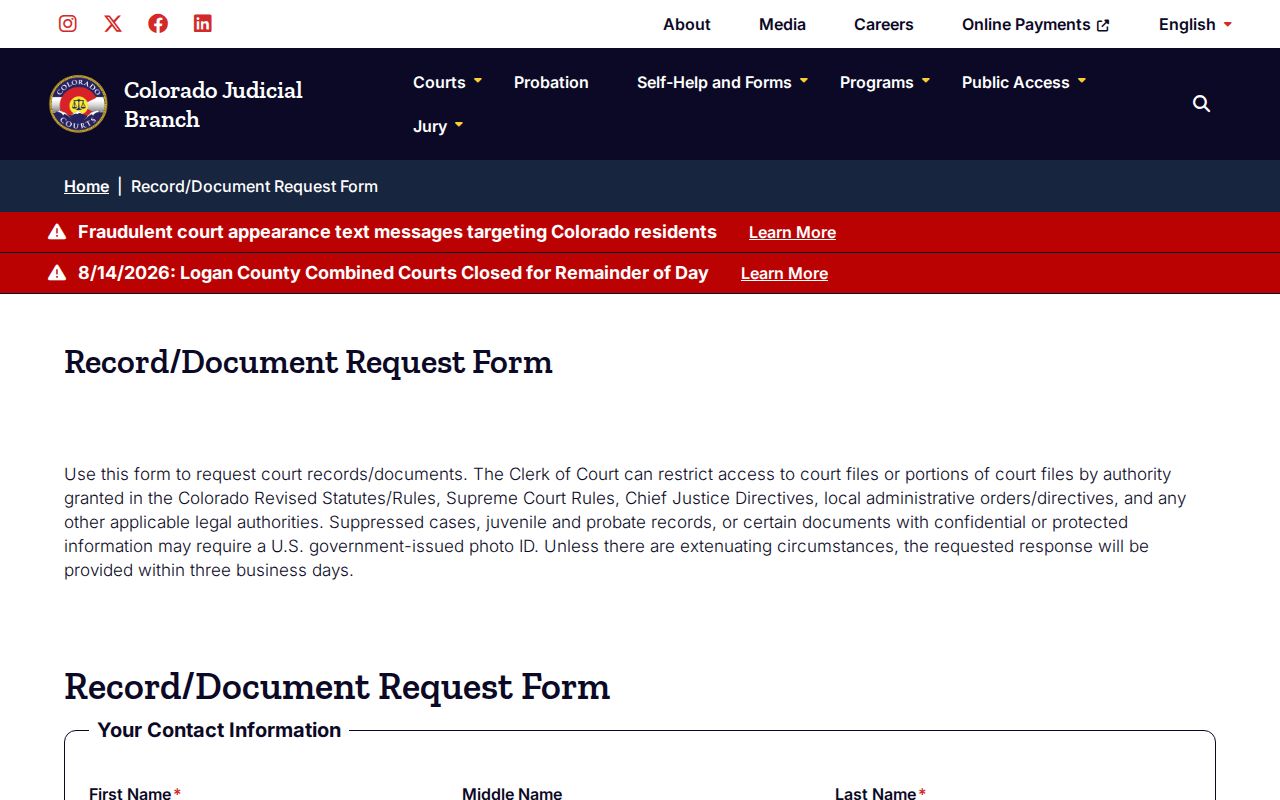
Why bother with a form? It tells the clerk whether you want the whole Hinsdale County case history or one paper filed in it. That difference matters. Give the exact case number if you have it. It points straight to the court record. Without one, list the names, the rough year, the case type, and the document you need. A tight request can spare you a paid name search and cut down the clerk's digging. Replies normally aim for three business days unless circumstances interfere. Treat that as a goal, not a promise.
Court Records: What They Contain
A full case file holds more than its docket. The header page names the court, the case number, the caption, the class, and the type. It notes whether the case is open or closed. Next comes the ROA, which lines up every filing and court act by date. The pleadings and signed orders sit behind those entries. You have to ask for them as documents. Money shows up too. Fines, fees, restitution, or a running balance may appear in the file. Access flags, though, can block parts of a public copy.
| Case Number | A year, class, and sequence, such as 2023AA123456; preserve all letters and leading zeros. |
|---|---|
| Caption | The official case title and the roles of the parties. |
| Register of Actions | A dated summary of filings, minute orders, settings, charges, sentences, and disposition. |
| Filed Papers | Complaints, petitions, motions, responses, notices, orders, judgments, tickets, and probate documents. |
| Restrictions | Sealed portions, protected identifiers, and access limits tied to statute, rule, directive, or court order. |
A closed label is just administrative bookkeeping. It does not erase the record. Keep the same caution with motions: a motion entry is a request, not a ruling, until the judge acts. A minute order may be the short written trace of that action.
Historic Hinsdale County Court Records
Hinsdale County blends two eras of recordkeeping. The courthouse dates to 1877 and still serves its original public and court functions. Colorado brought civil e-filing online statewide in 2013 and criminal e-filing in 2017. Even so, older files can sit in local storage or off site. The Judicial Branch itself notes something. The original Alferd Packer sentencing documents remain viewable at the courthouse.
Ask the clerk where the file is held before you drive out for an older Hinsdale County court record. Helpful details include an approximate year, the case class, a party name, and any known case number. Bring the exact document you need, too. Retrieval from off site is billed at actual cost. One more caution applies to the upstairs courtroom. It is reached by an original curved stair that is not accessible. Anyone needing an accommodation should contact the Seventh Judicial District ADA coordinator ahead of time rather than assume the historic route will work.
This history is why calling Hinsdale County "fully online" would mislead. A modern docket search can locate the case. The most useful or oldest court record may still require clerk review and physical retrieval.
Copy Fees and Certification
A plain copy just reproduces the court paper. Certification or exemplification adds authentication and raises the price. So ask the receiving office which form it requires before you order. Colorado's published schedule charges by page and by certified document. Research or redaction can add time-based costs. A good case number spares you a separate name-search charge.
| Item | Published Amount | How It Applies |
|---|---|---|
| Copy | $0.25 per page | Parties and their attorneys have a $15 per-case maximum; no maximum is stated for nonparties. |
| Certified or exemplified copy | $20 per document | Added to copy charges when applicable. |
| Transcript of judgment | $25 | A judgment record, not a hearing transcript. |
| Certificate of satisfaction | $20 | Used for a civil judgment record. |
| Name search | $5 | Avoidable when an exact case number is supplied. |
| Off-site retrieval | Actual cost | May apply to older files. |
| Research or redaction | $30 per hour | Billed in 15-minute units after the first hour. |
| CCE search | $0 | The pricing model effective September 2025 lists searching at no charge. |
| CCE case history | $15 | Applies when the user has not e-filed into the case and provides 14-day access. |
| CCE e-file or e-service | Generally $12 per transaction | Statutory filing charges may also apply. |
Hinsdale Combined Court Clerk
317 Henson Street
Lake City, CO 81235
970-944-2227
Note: The clerk counter currently opens only on the third Friday of each month. Confirm access before making a mountain trip.
Mailing Hinsdale County Court Records
A mail request works best when it names the court and case. It should list each document and state whether certification is needed. Add contact and delivery information, too. The statewide PDF form tells requesters to include identification and wait for a Notice of Fees by email. Pay by check or certified funds. Never put card details in the request itself. Mail goes to Hinsdale Combined Court, 317 Henson Street, Lake City, Colorado 81235.
Remote inquiries can also start by email or fax. The local address is HinsdaleClerk@judicial.state.co.us, the phone is 970-944-2227, and the fax is 970-944-2289. Confirm the fax arrived and ask what payment the clerk accepts. The courthouse promises no drop box or public terminal. So a phone call pays off when your request involves an older file, a protected record, or a delivery deadline.
Eligible parties have another option in CCE. A self-represented party in an eligible domestic or eviction case may opt into that person's own case. They wait up to two business days for approval and then view documents. CCE is not a general public records viewer. It cannot be used to enter another person's matter.
Access Rules for Court Records
Colorado Chief Justice Directive 05-01 controls access to Judicial Branch court records. It separates remote access, facility-only access, and excluded information. The Colorado Open Records Act covers public records broadly. But it does not override Judicial Branch rules for case files. A record may be missing from a public search for several reasons. It may be restricted, sealed, suppressed, or simply outside the date window you selected.
The current CJD 05-01 page is the best starting point. Amendments took effect several times in 2025. Sealing law offers automatic, simplified non-conviction, and petition routes. Eligibility turns on the case and its outcome. Sealing limits public access without necessarily destroying the judicial file. Identification proves who you are. It does not grant a right to inspect every protected record.
That official page lays out the source rules that govern Hinsdale County court record access.
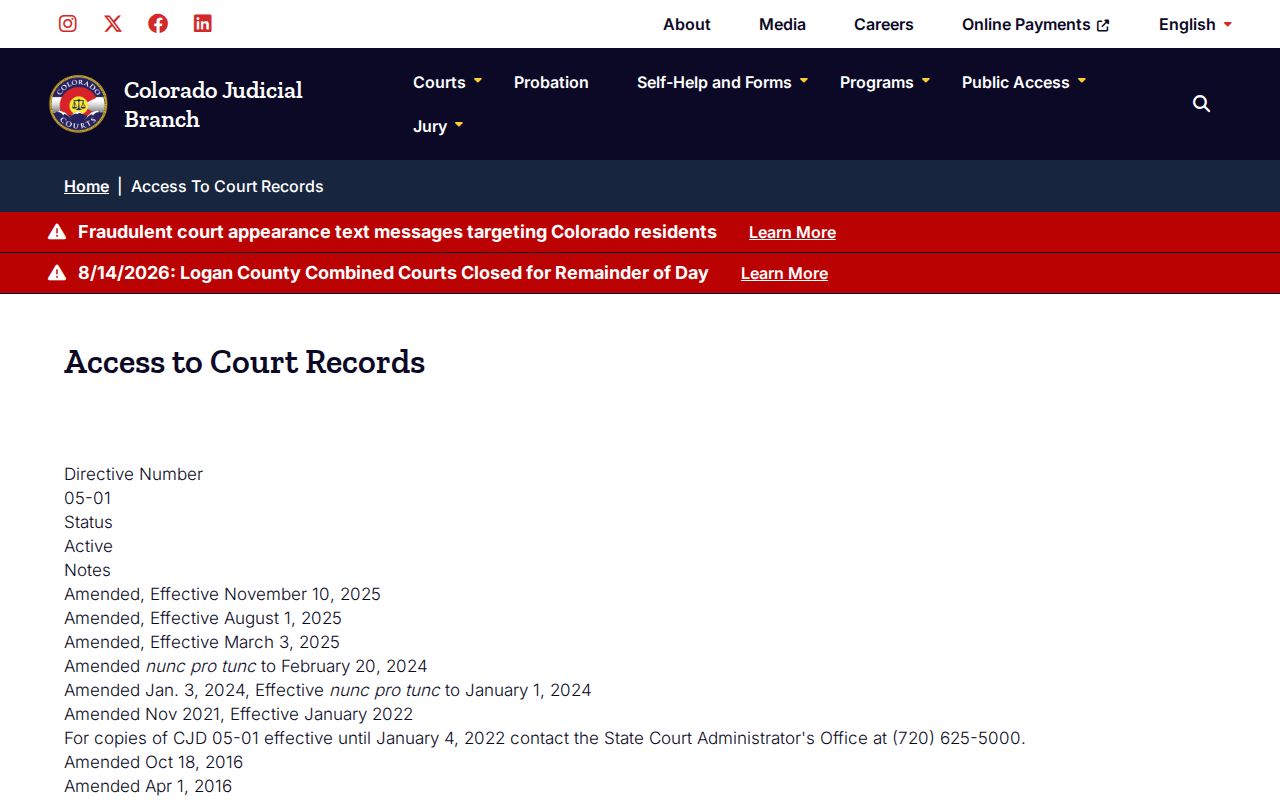
The directive also explains why vendor results and clerk copies can differ. The court that accepted the filing remains the source of the official record.
Key access rules: CJD 05-01 governs court-file access, CJD 06-01 supplies court fees, and C.R.S. sections 24-72-701 through 710 address sealing processes.
Federal Hinsdale County Court Records
A federal case tied to Hinsdale County does not land in Hinsdale Combined Court. Federal trials belong to the U.S. District Court for the District of Colorado, bankruptcy to the U.S. Bankruptcy Court for the District of Colorado, and appeals to the Tenth Circuit. PACER pairs a numbered federal docket sheet with many linked documents, unlike Colorado's state mix of a free schedule finder, vendor ROAs, and clerk-held official papers.
The bankruptcy court's official copy information shows the separate federal channels available for bankruptcy records.
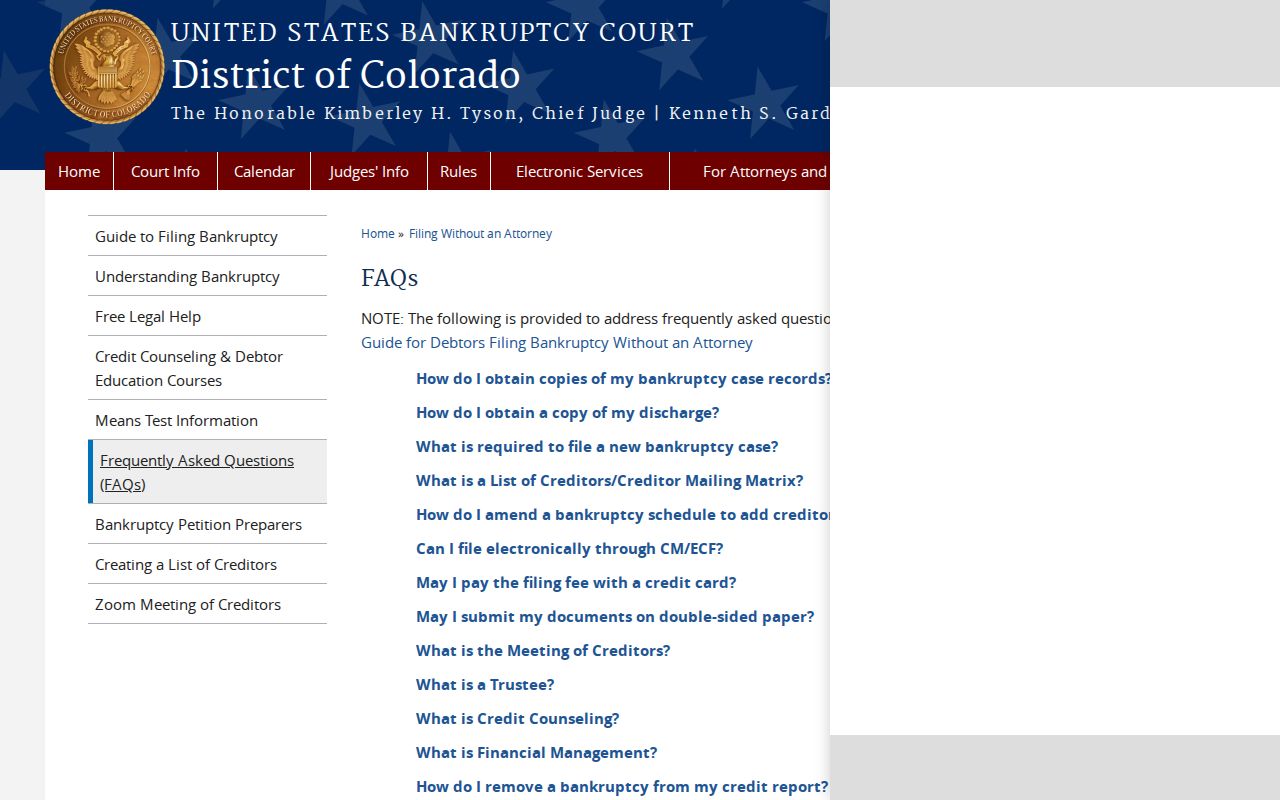
Knowing the difference keeps a request from going to the wrong clerk. A state case never appears in PACER just because it raises a federal issue. It must actually be filed in or removed to federal court. RECAP may hold contributed federal copies for free. But its coverage is incomplete and cannot replace the federal court record. Whatever the system, settle identity first. State or federal, trial or municipal, docket entry or filed paper. Order only after that.